

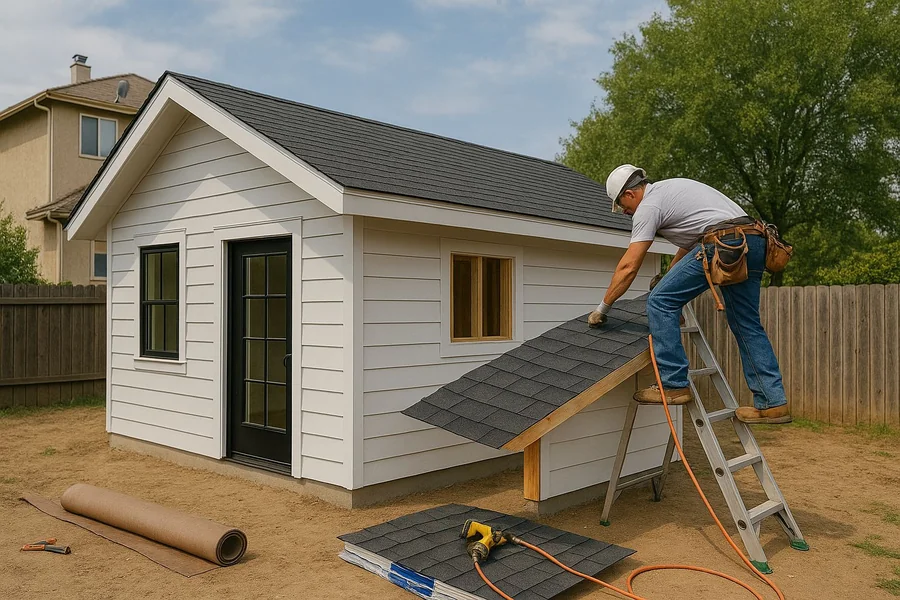

Under California law, new construction is assessed when completed, but only the new construction. A homeowner whose house carries a Proposition 13 base from a 1998 purchase keeps that base untouched when a backyard cottage rises behind it. The county assessor adds a supplemental assessment reflecting the value the ADU contributes, typically landing near its construction cost, and the owner’s bill grows by roughly one to one and a quarter percent of that added value per year. On a $250,000 unit, that means approximately $2,500 to $3,100 in new annual tax, against rental income that in most Bay Area neighborhoods exceeds that figure monthly.
How the Assessment Actually Unfolds
The explainer traces the process homeowners will experience. When the ADU permit finals, the city notifies the county assessor, who values the new construction, usually from permit valuation, cost figures, and comparable data, and issues a supplemental assessment for the partial year, followed by inclusion in the next regular roll. Homeowners receive a notice, and in Santa Clara County the paperwork generally arrives within months of final inspection. The main house’s assessed value does not reopen. The land’s assessed value does not reopen. The purchase-year base and its two-percent annual cap continue exactly as before.
The company built the explainer around real project examples because abstractions soothe no one. One documented case: a Cambrian-area homeowner with a main house assessed at $380,000 under a 2004 base built a $230,000 detached one-bedroom. Post-construction, the property’s assessed total rose to roughly $610,000, the main house portion unchanged, and the annual tax bill grew by about $2,700. The unit rents for $2,750 a month. The owner’s stated regret, recorded in the company’s client survey, was waiting three years to build because a neighbor had warned, incorrectly, that the whole property would be reassessed at market value.
The full explainer is available through adubuildersbayarea.com, alongside the company’s feasibility, design, and construction services.
The Myths the Explainer Retires
The document addresses the folklore one claim at a time. Building an ADU does not reassess the main home: reassessment of the whole property happens at change of ownership, not at new construction. Pulling a permit does not invite the assessor to revalue the existing house, and the company notes the opposite risk is the real one: unpermitted construction discovered later generates back assessments, penalties, and a resale file no buyer’s lender will accept. A garage conversion is assessed like any new construction, but typically at lower added value than a detached build, since the structure existed. And an ADU does not affect a parent-child transfer’s tax treatment in the ways most forum threads claim, though post-2021 rules under Proposition 19 have genuinely changed intergenerational transfer math, which is precisely where the explainer tells readers to stop reading builders and start consulting tax professionals.
The explainer is likewise candid about what does raise taxes beyond the supplemental assessment: voter-approved bonds and parcel taxes apply to the property as they always did, and a future sale resets everything at the new purchase price under the same rules that have governed California real estate since 1978. An ADU changes none of that machinery; it simply adds one well-defined increment to it.
Why a Builder Is Publishing Tax Guidance
The company is explicit that it is not a tax advisor and the explainer is not advice. It published the document because assessment fear was measurably distorting good decisions: homeowners shrinking projects to stay under imagined thresholds, delaying builds while rents compounded past them, or, worst, building without permits to stay invisible, a strategy that fails at the first aerial imagery update the assessor runs and costs multiples of the tax it dodged. Santa Clara County, like most Bay Area assessors, reviews building permits and imagery routinely; the explainer’s standing counsel is that the visible, permitted, properly assessed unit is the only version worth owning.
“The tax question comes up in the first ten minutes of almost every consultation, and the fear is always bigger than the number,” said a company spokesperson for ADU Builders Bay Area. “When we show homeowners that a quarter-million-dollar unit adds about two hundred fifty dollars a month to the tax bill and three thousand a month to the rent roll, the conversation changes immediately. Proposition 13 protects their base. The ADU is assessed on its own. Nobody loses their 1998 tax bill for building a cottage in 2026.”
Supplemental Assessment Planning Inside the Project Budget
The explainer folds the tax increment into the company’s standard budgeting practice. Every project proposal now includes an estimated supplemental assessment line, so the first-year carrying cost of the finished unit, loan payment, insurance endorsement, and tax increment together, sits beside projected rent on one page. The company also flags the timing quirk that catches owners off guard: supplemental bills arrive on their own schedule, separate from the regular installments, and escrowed mortgages do not always capture them automatically, so the first year calls for a little attention to the mailbox.
For owners pursuing condo-ready construction or an eventual AB 1033 separate sale, the explainer adds the forward-looking chapter: a separately sold ADU is assessed to its buyer at the sale price as a new parcel event, while the original home keeps its base, a structure that makes the tax conversation at sale time straightforward but worth professional review before listing. And for multifamily owners adding units under the expanded 2026 rules, the same new-construction principle applies at building scale, with each added unit assessed as an increment rather than reopening the building’s base.
Resale Value, Appraisals, and the Documented Unit
The explainer closes the loop between taxes and value. The same permitted, assessed status that adds a modest tax increment is what lets appraisers credit the unit at resale and lets buyers’ lenders count its income. Bay Area appraisal practice has matured considerably on this point: permitted ADUs with clean documentation now routinely contribute value at or near construction cost in the company’s recent client resales, while unpermitted units contribute little, complicate financing, and in several observed transactions actively reduced offers because buyers priced in legalization costs. The tax bill, in other words, is the receipt that proves the asset exists.
For homeowners weighing the long arithmetic, the explainer offers a ten-year view on a representative project: a $250,000 unit financed on equity, renting at $2,600 with modest annual increases, carrying roughly $2,800 a year in incremental tax growing at the capped two percent. Across the decade, cumulative tax on the unit totals around $31,000 against gross rents exceeding $330,000, before the unit’s contribution to the property’s eventual sale price. The company presents the table not as a promise but as a scale: the tax question, examined, is a line item, not a verdict.
The document also lists the three situations where owners genuinely should slow down and get professional advice: properties held in trusts with pending intergenerational transfers under Proposition 19, owners contemplating an AB 1033 separate sale within a few years, and properties with existing unpermitted structures whose legalization should be sequenced thoughtfully alongside new construction. For everyone else, the explainer’s message is the one the company’s project history supports: build the unit, take the supplemental bill out of the mailbox, and let the rent checks answer it.
The Fall 2026 Window
The explainer’s release is timed to decision season. Homeowners who resolve the tax question this fall and move into design hold permits by late winter and finish units in 2027, with the supplemental assessment arriving only after completion, meaning the tax increment starts when the rental income does, not before. The company pairs the document with its free feasibility consultations, where the assessment estimate is calculated for the owner’s actual parcel and unit type rather than a hypothetical, using current county rates and the project’s real budget.
Homeowners across San Jose, Santa Clara County, and the greater Bay Area who have postponed an ADU over property tax uncertainty are encouraged to contact ADU Builders Bay Area for an evaluation that puts real numbers on the question. The company provides guidance on feasibility, design, permitting, budgeting, and construction scheduling, and its team works with each homeowner to match the project to the realities of the site, the budget, and the tax picture.
The explainer is distributed free of charge and without registration, and the company updates it annually as county practices and state law evolve. Readers are reminded throughout that assessors, not builders, make assessment decisions, and that a thirty-minute call to the Santa Clara County Assessor’s office or a session with a tax professional remains the right final step for any owner whose situation carries unusual facts. What the document removes is the fog in between, the secondhand warnings and forum myths that have kept sensible projects on the shelf for years while rents, construction costs, and family needs kept moving.
About ADU Builders Bay Area
ADU Builders Bay Area is a San Jose based accessory dwelling unit builder serving homeowners throughout the Bay Area. The company provides ADU design, planning, permitting, and construction services for detached ADUs, attached ADUs, garage conversions, junior ADUs, backyard cottages, in-law units, and custom secondary housing structures. Its work is centered on local expertise, efficient project delivery, and functional residential design for California homeowners.
ADU Builders Bay Area
111 N Market St Suite 378
San Jose, CA 95113, United States
Phone: (669) 288-5648
https://adubuildersbayarea.com
