


You may already be bracing for the answer before you even sit in the chair. One dentist says the tooth might be saved. Another mentions an implant. You hear words like fracture, bone loss, infection, root canal, crown, and suddenly the decision feels bigger than one tooth. It affects your comfort, your budget, your time, and your trust. That is why seeking comprehensive dental care Great Falls can help you make the most informed decision.
That is why saving a tooth or replacing it with an implant should start with a full dental exam, not a rushed opinion based on one sore spot. A complete exam looks at the tooth, the gums, the bone, your bite, your medical history, and the condition of nearby teeth. The goal is simple. Keep a natural tooth when it has a real chance to last, and choose an implant when keeping the tooth would lead to more pain, more cost, or repeated treatment.
A proper dental exam gives you the facts you need before you commit to either path. That first step often lowers the stress because the choice stops feeling like guesswork.
A full dental exam reveals whether the tooth can truly be saved
A damaged tooth can look hopeless and still be treatable. The opposite happens too. A tooth that seems stable can have a crack below the gumline, deep decay, or bone loss that makes long term success unlikely. Pain alone does not tell the whole story. Some teeth hurt badly and are very treatable. Others barely hurt and are already failing.
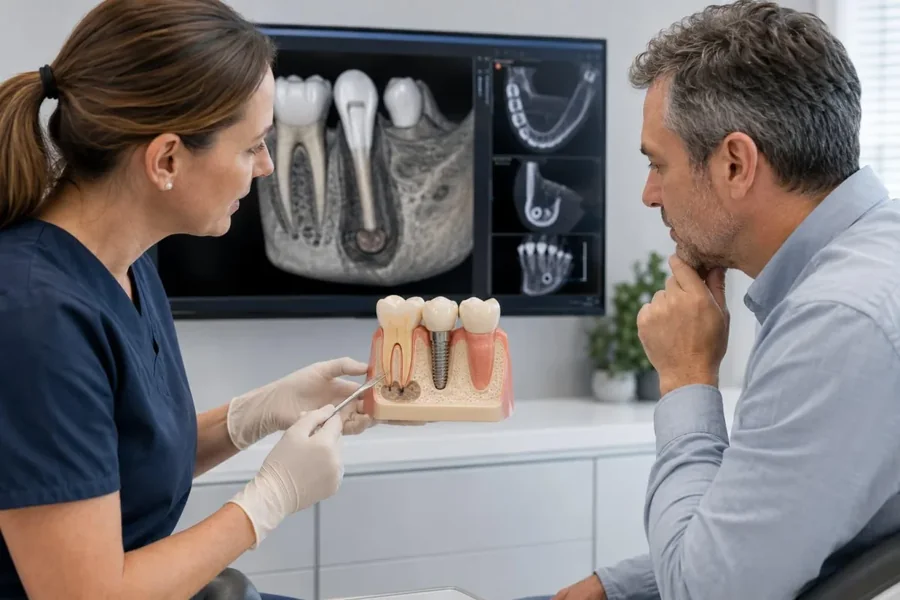
During a full exam, the dentist checks for decay, cracks, infection, loose movement, gum pocket depth, bite pressure, and bone support. X-rays and sometimes 3D imaging show what the eye cannot see. If the nerve is infected but the root structure is strong, root canal treatment and a crown may save the tooth for years. If the tooth is split or the bone support is poor, trying to save it may only delay the next problem.
This is where many people get stuck. You do not want to remove a tooth that could have been kept. You also do not want to spend money on treatment that fails six months later. A complete evaluation gives the decision some structure.
Dental implant versus tooth preservation is rarely just about one procedure
The choice is often framed too simply. Save the tooth or get an implant. Real life is not that neat. Saving a tooth may involve a filling, root canal, gum treatment, crown lengthening, or a new crown. Replacing a tooth may involve extraction, bone grafting, healing time, implant placement, and a final crown. Each path has its own timeline and costs.
If you are weighing a dental implant versus saving a natural tooth, think about the full picture. How healthy is the surrounding gum tissue? Do you grind your teeth? Is the tooth in a high pressure area like a back molar? Has it already been treated more than once? These details change the outlook.
Adults often delay care because cost is real and dental fear is real. The result can be worse pain, swelling, and more limited options later. The HRSA oral health guidance for adults points to routine care as part of preventing larger problems. A full exam is not just a formality. It protects your options.
General and implant dentist care works best when the decision is based on long term function
A natural tooth has advantages. It is already part of your mouth, anchored by its own root, and often worth keeping when the structure is sound. An implant can also be an excellent option when the tooth cannot be predictably saved. Dental implants are medical devices, and the FDA explains what patients should know about dental implants, including the need for planning, healing, and follow up care.
The right answer depends on predictability. If a tooth needs repeated patchwork and still has a poor outlook, replacing it may be the cleaner solution. If the tooth can be restored with a strong chance of lasting, preserving it may be the smarter move. Good care is not about pushing one treatment. It is about matching the treatment to the condition in front of you.
Comparing tooth saving and implant replacement side by side
| Factor | Saving the Natural Tooth | Replacing With an Implant |
| Best fit | Tooth has enough healthy structure, stable bone, and a restorable root | Tooth is cracked beyond repair, severely decayed, or has poor long term support |
| Common treatments | Filling, root canal, crown, gum treatment | Extraction, possible bone graft, implant placement, crown |
| Timeline | Often faster if the tooth is straightforward to restore | Often longer due to healing and staged treatment |
| Upfront cost | May be lower at first, depending on treatment needed | Often higher at the start |
| Long term concern | Risk of reinfection, fracture, or future retreatment | Risk of implant failure, gum inflammation, or bone issues if not maintained |
| Feel and function | Keeps your natural tooth structure and bite feel | Restores chewing and appearance when a tooth is no longer savable |
Clear steps help you decide between tooth repair and tooth replacement
Get a full diagnostic exam. Ask for a clear explanation of the tooth, the bone, and the gum support. If imaging is recommended, ask what it will show that a basic X-ray cannot. You need to know whether the tooth is restorable, not just whether it can be treated today.
Ask for the prognosis of each option. Do not stop at price. Ask how long the saved tooth is expected to last, what could make it fail, and what maintenance an implant would require. This turns the choice from a short term fix into a long term plan.
Think about your real life, not an ideal one. If you know you clench your teeth, miss cleanings, or need the fastest route back to comfortable chewing, say that openly. Treatment only works when it fits your habits, schedule, and budget.
The best decision starts with a complete evaluation
You do not need to decide this based on fear or pressure. Tooth replacement options and tooth saving treatments both have a place, and the better path becomes clearer when the exam is thorough. A good plan protects your health, your function, and your money.
If you are facing a painful or damaged tooth, start with a full evaluation from a general and implant dentist. The next step should be based on what gives you the strongest, most reliable result for the years ahead.
